News Detail
Indonesia Targets Achieving Net-Zero Emissions by 2060
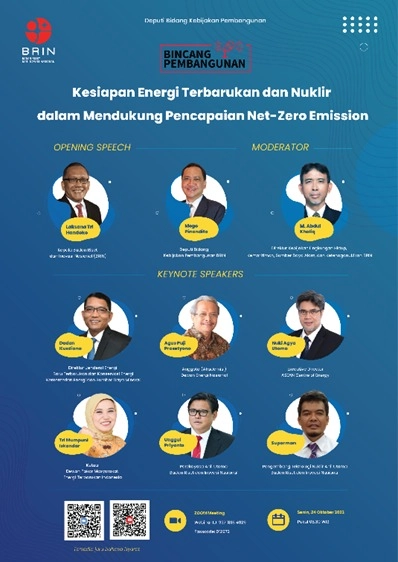
Jakarta - BRIN Public Relations. The National Research and Innovation Agency (BRIN) through the Deputy for Development Policy will hold a Talk show on Development Series VIII at the Auditorium of the Widya Graja Building, 2nd Floor, BRIN Gatot Subroto Campus, Jakarta, Monday (24/10). The theme is the Readiness of Renewable and Nuclear Energy to Support the Achievement of Net-Zero Emissions.
Currently, the issue of
climate change is the focus of the world's attention. Through the Paris
Agreement stipulated at the COP-21 in Paris, the world is committed to
containing a global temperature rise of 2oC and is working further
to limit it to 1.5oC above the pre-industrial era.
As its commitment, in
overcoming the threat of climate change caused by greenhouse gas (GHG)
emissions, Indonesia has ratified the Paris Agreement through Law no. 16 of
2016 and incorporates the actions of climate resilience in the Enhanced
Nationally Determined Contribution (ENDC) document. In this document, Indonesia
aims to reduce greenhouse gas emissions by 31.89% with its own efforts, and up
to 43.20% with international assistance by 2030. Indonesia's climate commitment
was also strengthened at the COP-26 in Glasgow by setting a target of achieving
Net-Zero Emissions in 2060 or sooner.
Chairman of BRIN, Laksana
Tri Handoko, stated that the use of renewable and nuclear energy is a solution
to meet the national energy needs and at the same time reduce greenhouse gas
emissions in an effort to achieve Net-Zero Emission. However, there are several
things that need to be considered in this effort.
"Reflecting from the
energy crisis that occurred in several countries in the world, the transition
to renewable energy and nuclear energy must consider the aspects of energy
trilemma, namely energy security (security of energy supply and resilience from
shocks in the global energy market), energy equity (universal access at an
affordable price), and environmental sustainability (using clean and
sustainable energy)”, he explained.
Handoko added that the
development of renewable and nuclear energy in Indonesia must be supported by
impartial policies and regulations, quality research and technology innovation
activities, innovative and sustainable financing sources, as well as strong
multihelix collaboration and synergy between the government, private sector,
industry, academia, NGOs and the community.
For this reason, Handoko
hoped that the Development Talk activity could serve as a medium for exchanging
information, ideas related to the readiness and challenges of using renewable
and nuclear energy, so that comprehensive solutions can be obtained to formulate
recommendations for decision or policy makers.
"I truly hope that
this Series VIII Development Talk can be optimized to find a comprehensive
solution in formulating the right policies related to strategic issues in
National Energy Development, and as inputs for decision or policy makers,"
hoped Handoko.
BRIN's Deputy for
Development Policy, Mego Pinandito, stated that energy is an essential sector
for community survival and national economic growth. Therefore, the use of
renewable and nuclear energy must be aimed at achieving national energy
independence and security.
"With regard to the
use of renewable and nuclear energy, we must continue to maintain collaboration
with other countries, especially our neighbors in ASEAN. The collaboration can
be in the form of sharing best practices, funding, key technologies, and so
on,” he added.
The Series VIII Development
Talk will present resource persons; Dadan Kudiana (Director General of New
Renewable Energy and Energy Conservation of the Ministry of Energy and Mineral
Resources), Agus Puji Prasetyono (Member of the National Energy Council), Nuki
Agya Utama (Executive Director of ASEAN Center of Energy), Tri Mumpuni Iskandar
(Chairman of the Expert Council of the Indonesian Renewable Energy Society),
Unggul Priyanto (Senior Engineer of the National Research and Innovation
Agency), and Suparman (Senior Expert in Nuclear Technology Development of the
National Research and Innovation Agency), and M. Abdul Kholiq (Director of BRIN’s
Environmental Policy, Maritime Affairs, Natural Resources, and Nuclear) acting
as the moderator.