News Detail
Russia-Ukraine Conflict Affects International Geopolitical Order
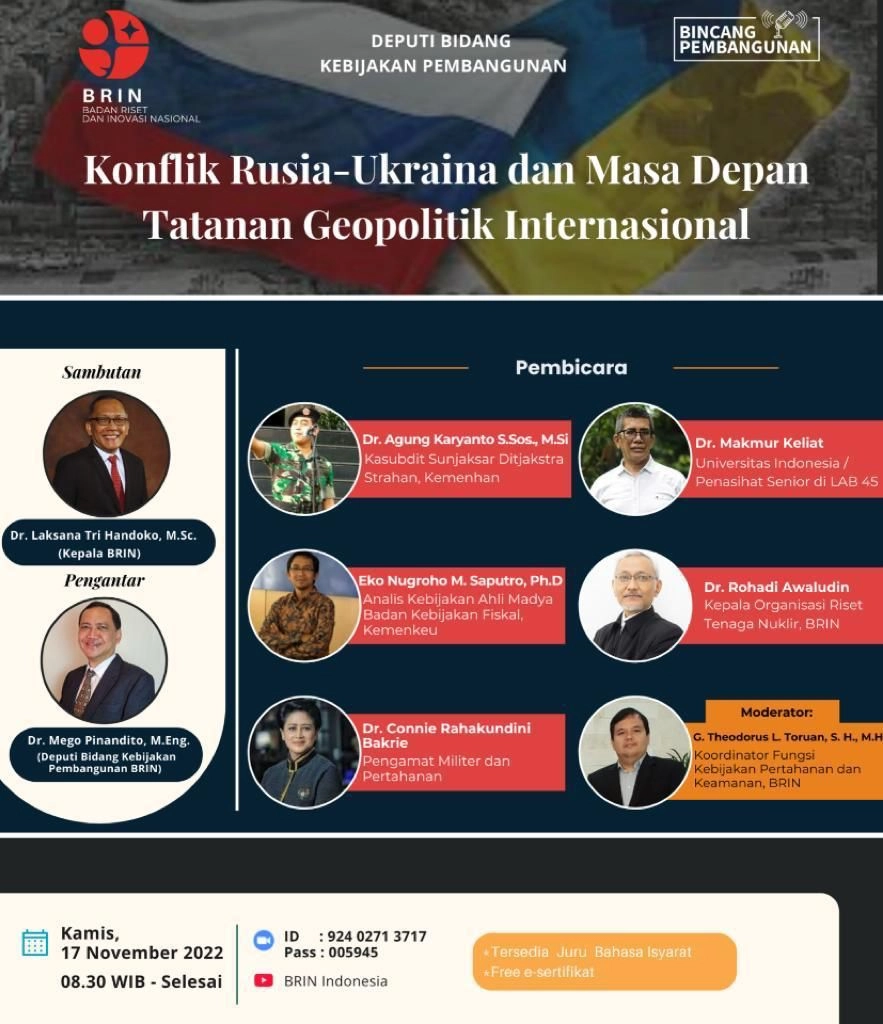
Jakarta – BRIN
Public Relations. The protracted Russia-Ukraine conflict since 24 February 2022
has sent not only shock waves throughout the world, but also has a systemic
impact globally, especially in the stability of defense, security and the world
economy. This also affects Indonesia, which has a high dependence on imports of
wheat from Ukraine. To deal with this situation, the Deputy for Development
Policy of the National Research and Innovation Agency (BRIN) will hold a Series
X Development Talk which will carry the theme "Russia-Ukraine Conflict and
the Future of International Geopolitical Order", at the Auditorium of the
Widya Graha Building, 2nd Floor, BRIN Gatot Subroto Campus, Thursday (17/11).
At a time when countries around the world are recovering from the COVID-19 pandemic, the world is faced with a situation of crisis threat as an implication of the Russia-Ukraine conflict. The impacts that are felt the most in the world today, among others, are increasing food insecurity, limited access to energy, and rising inflation. These pose challenges to the world order and peace.
BRIN Deputy
for Development Policy Mego Pinandito said that at the international level,
Indonesia has endeavoured to play an active role as a mediator and realize a
peace mission by making state visits to Ukraine on 29 June 2022 and Russia on 30
June 2022. Various efforts on sidelines of meetings in multilateral forums have
also been made.
"Countries
around the world are expected to provide a quick and accurate response,
individually and collectively, to deal with the current turbulent world geopolitics.
Indonesia in particular, also needs to protect its national interests, but
still maintain the principle of a free and active foreign policy," said
Mego.
Therefore,
the National Research and Innovation Agency tries to observe and examine the issue
of impact of the Russia and Ukraine conflict. This is based on the urgency to
understand the latest developments and the current world geopolitical dynamics
as implications of long-standing Russia-Ukraine conflict.
"We hope
insights from experts’ presentations and discussions related to several
important points about geopolitical dynamics that have become the world's
attention in the past few months will be considered and pay attention to in
order to formulate policies, and become a medium for understanding problems and
various strategic issues that occur, not only at home, but also internationally
now and in the future,” hoped Mego.
According to
Mego, there are three major issues that need attention along with the
implications of the Russia-Ukraine conflict. First, the Russia-Ukraine conflict
has contributed to possible changes in the global geopolitical constellation, one
of which is the possibility of a shift in the geopolitical map and the
emergence of a new balance of power in the world. Such shift and change in the
global geopolitical constellation are important to observe and Indonesia needs
to be prepared for the implications this process brings.
Second, there
will be possible use of nuclear force. In response to this, actors around the
world, especially state actors, are experiencing uncertain conditions and need
to start making projections on the possible use of nuclear in this conflict.
“For
Indonesia, the possibility of using nuclear force is very important to be
analyzed and observed, not only from the perspective of security and
international law, but also from the perspective of science. Use of nuclear
power is not only against humanitarian law, but also has major impacts such as
loss of life, material losses, and health risks," said Mego.
Third, Mego
continued, the Russia-Ukraine conflict has had a systemic impact throughout the
world, especially to countries that have direct trade relations with Russia or
Ukraine. The Indonesian government needs to mitigate the condition as the Russian-Ukrainian
conflict can have further implications for Indonesia's national interests, not
only in the economic and energy sectors, but also in the security and defense
sectors.
In
particular, said Mego, Indonesia needs to protect its national interests in
several ways. This includes maintaining Indonesia's credibility at the
international level and multilateral forums, by prioritizing a foreign policy
that is free and active without being driven by any party; maintaining defense
and security stability; maintaining the security of Indonesian food
commodities, responding to and anticipating the possibility of using nuclear
power in Indonesia's capacity as a developing and middle power country; and
ensuring lasting peace in accordance with the mandate of the Preamble to the
1945 State Constitution.