News Detail
BRIN Emphasizes 5 Things to Realize National Food Security, Sovereignty and Self-Sufficiency
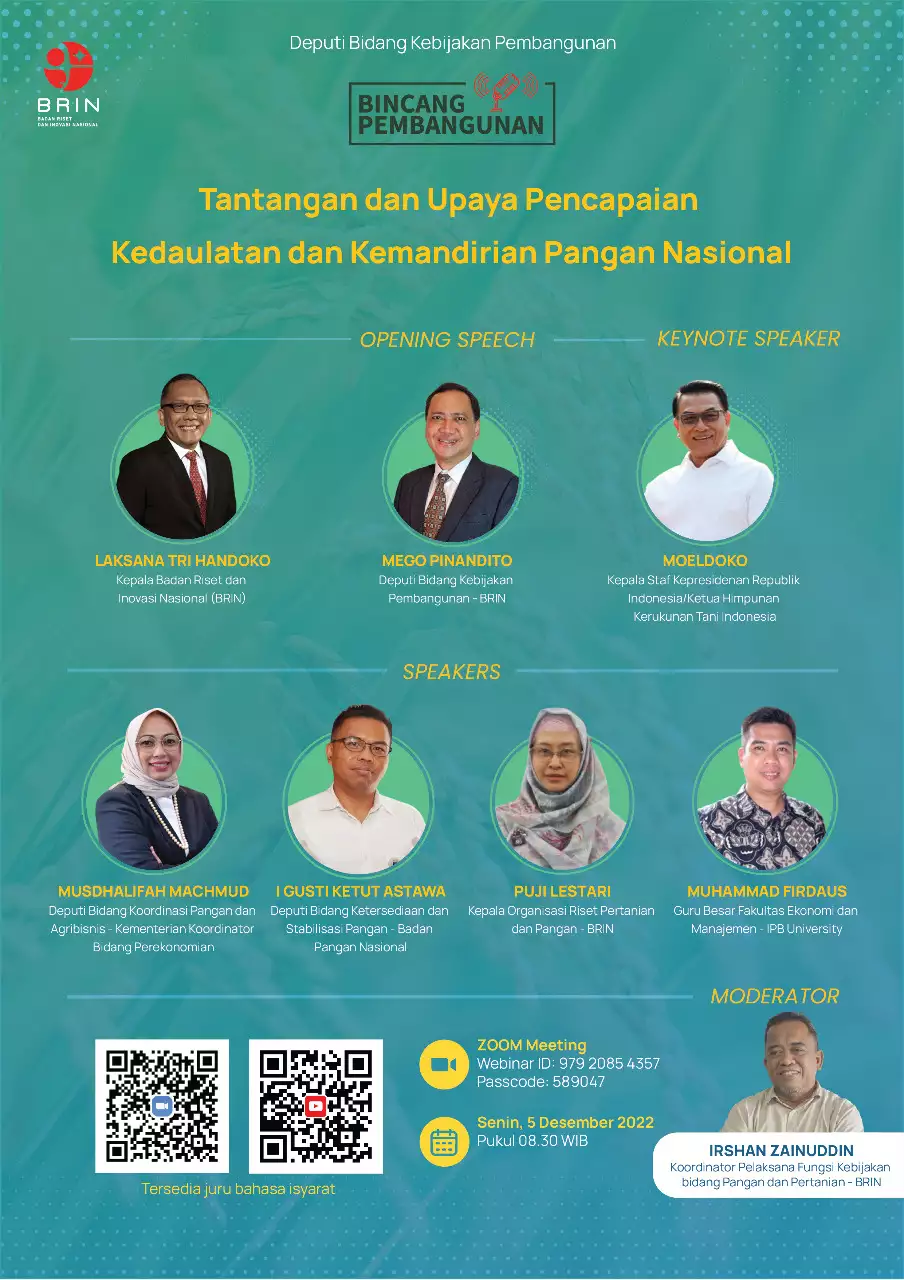
Jakarta – BRIN Public Relations. Law number 18 of 2012 concerning Food and the Nawacita document stipulates that food issues are aimed at achieving food sovereignty, food self-sufficiency and food security, because food is human’s primary need that must be fulfilled both individually and as a state. Food is a very strategic issue that needs quick and precise solutions. To discuss the readiness, challenges and efforts related to food sovereignty and self-sufficiency, the Deputy for Development Policy of the National Research and Innovation Agency (BRIN) will hold a Series XII "Development Talk" talkshow under the theme "Challenges and Efforts to Achieve National Food Sovereignty and Self-Sufficiency", at the Widya Graha Auditorium 2nd Floor, BRIN Gatot Subroto Area, Monday (5/12).
Warning of impending food and energy crisis has become a global issue that all countries must observe, including Indonesia. The World Food and Agriculture Organization (FAO) has even issued a warning regarding the threat of world food crisis which will result in not only a spike in energy prices, but also food and fertilizer prices. This raises concerns about disrupted global food security, coupled with the climate crisis and the prolonged conflict between Russia and Ukraine.
Based on the targets as set out in the 2020-2024 National Medium-Term Development Plan (RPJMN), Indonesia's food security score is 95.2. However, in fact, Indonesia's food security score in the Global Food Security Index ranks 63 out of 113 countries with a score of 60.2.
Deputy Chair for Development Policy of the National Research and Innovation Agency (BRIN) Mego Pinandito emphasized several things that need attention related to national food security, sovereignty and self-sufficiency. First, the Covid-19 pandemic which continues to affect to this day, the food crisis, and the Russia-Ukraine war that has not ended.
"The world's ever changing political conditions demand that we together not only strive to achieve food security, but must realize food sovereignty. This world crisis must be used as a momentum for Indonesia's food sovereignty," said Mego.
Second, the Ministers of Finance and Ministers of Agriculture of the G20 countries have confirmed their commitment to utilize all policy tools in addressing current economic and financial challenges, including food security.
Third, policies and regulations that are firm, aligned, and in favor of application of a Sustainable National Food System. "It is necessary to carry out governance of food sovereignty-oriented agricultural development through strengthening and policies on access to production inputs, so we would no longer depend on non-local resources, "he asserted.
Fourth, strengthening research activities and technological innovation through synergy and collaboration between the government, private sector, industry, academics, NGOs and the community. Research activities must of course be aligned with the direction of agricultural development such as: Diversification and development of local food; Optimization of productive lands and sustainable innovation.
Fifth, innovative and sustainable sources of funding related to achieving national food sovereignty and self-sufficiency, to ensure that sustainable agricultural development measures not burden state finances and maintain the national economy.
Mego added, geographically and geopolitically, Indonesia will also be affected, if we do not take anticipatory measures by making the appropriate policies to realize National Food Security.
"Food independence needs to be strengthened by not relying on imported food, which will eventually result in food sovereignty, namely by making use biodiversity, restoring local food diversity, and building agriculture-based industries in rural areas," he said.
According to Mego, there are five components in realizing food self-sufficiency, namely sufficient availability, stability of availability, affordability, good quality/food safety, and no dependence on outsiders. Food self-sufficiency creates high resilience against developments and world economic turmoil.
"Food security is very important in maintaining food sovereignty and self-sufficiency. One solution is to increase local food production. Local food development according to the characteristics of each region will be our strength in anticipating food crisis," continued Mego.
Large potential of local food resources and high biodiversity available in Indonesia make it possible to support the provision of diverse and quality food. For this reason, policies are needed on how these local food commodities can be increased in production including their diversification, availability and ease of market access. By observing the essence of Sustainable Development Goals number 2, namely ending starvation, achieving food security, improving nutrition and promoting sustainable agriculture, this needs to be echoed continuously.
Mego hoped that this Series XII Development Talk can be optimized to seek comprehensive solutions in formulating appropriate policies related to strategic issues in achieving national food sovereignty and self-sufficiency, as inputs for decision or policy makers.