IDEN
News Detail
11,3 million Tons of Garbage in Indonesia are Mismanaged
Published on July 26, 2024
Jakarta-BRIN Public Relations According to the National Waste Management Information System (SIPSN) data of the Ministry of Environment and Forestry (KLHK) in 2023, as of July 24, 2024, input from 290 cities/regions in Indonesia indicated that the amount of national garbage deposits reached 31,9 million tons. Of the total national waste production, 63,3% or 20,5 million tons can be managed, while the remaining 35,67% or 11,3 million tons are unmanaged.
In dealing with the problem of garbage that tends to increase as a consequence of the increasing population, plus with landfills and waste management that are limited in number is a crucial problem to solve.
The statement was submitted by the Director of Dissemination and Utilization of Regional Research and Innovation to the Deputy for Regional Research and Innovation (RID) of the National Research Innovation Agency (BRIN) at the opening of the Webinar on Waste Management for Environmental and Economic Benefits, Thursday (25/07).
"Not just now, but in to the future. Not to mention the public's awareness of good or bad waste management, even those that are even or that are not even or not at all. It requires efforts from central and regional governments to formulate and implement policies," Oetami added.
According to her, a collaborative program or collaboration between stakeholders in managing garbage is properly implemented. Leading the principle of a circular economy, where there is an increase in the economic benefits of garbage. So it is not considered a burden but is also considered as one of the potential.
“In addition, we also need to cultivate a common awareness to engage or raise, invite public involvement in the management of garbage. It is one form of social capital to create a clean, healthy, and fit culture, as part of the identity and character of Indonesian society,” she added.
Yudi Hidayat, Product Development Manager of PLN Indonesia Power Unit Suralaya Power Plant Business Cilegon explains about Cofiring BBJP at PLTU. Cofiring is a combustion on PLTU between coal and biomass fuel mix in this case BBJB or Refused Derived Fuel. While BBJB itself is a fuel from garbage that has undergone processes of selection and homogenity into a fleck size.
PT Indonesia Power is a Sub Holding PT PLN Persero which holds a strategic role in the electricity sector in Indonesia. "The main business activity of our company is as an energy solution provider that covers the supply of electricity through power generation spread in Indonesia, as well as the development of business beyond KWh," he said.
Currently PLN Indonesia Power manages 21.08 GW of plant as asset owner and O&M of plant across Indonesia. From Papua to the west is in Medan, the north is in Berau, and the south is in NTB.
"Profile per type of plant, covers PLTU 9.66 GW of 50 engines, PLTG/GU/MG 7.73 GW there are 107 engines PLTD 0.49 GW 145 engins, PLTP 0.81 GW there is 21 machines, PLTA 1.65 GW of 86 engines. For a mixture of EBT capacity of 2.46 GW or 12% and Non EBT of 17.89 GW or 88%," he said.
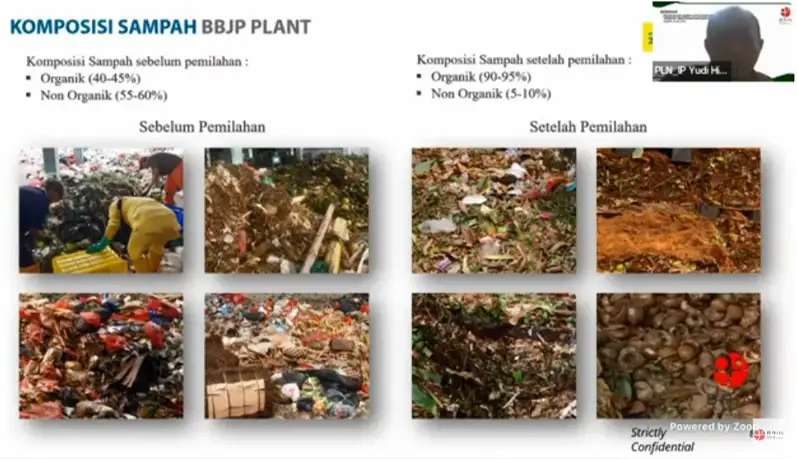
Yudi said, the composition of BBJP Plant's garbage before clearance is 40-45% organic and 55-60% non-organic. Next, the composition of garbage after cleaning for organic 90-95% and non-organic 5-10%
The next speaker, Muhriji, Head of Waste Management and Surveillance, Environmental Services of Cilegon City, Banten Province explains, Cilegon is one of the cities in the province of Banten there are 8 districts/cities and an area of 162,5 KM2.
"The city of Cilegon has a number of Technical Service Executives Units (UPTDs) of 4 territories, and 1 UPTD TPSA Bagendung. The land area of the UPTd TPSa Bagendunge is 8.6 Ha, the volume of garbage is 340 tons/day, the amount of waste processed in the TPSS Bagendonge is 265 tonnes/day. The amount of the trash banks is 38, and the number of the collection boxes is 64," he said.
He revealed that the amount of garbage in the City of Cilegon is the most than the population's waste as household waste of 273.51 tons/day, while the least is hospital waste of 0.06 tonnes/day.
“Opportunities with the presence of PT. Indonesia Power in Cilegon, which uses coal as a fuel of 40 thousand tons/day. While the City of CIlegon is not included in the city/district designated in Perpres No. 35 Year 2018 on the acceleration of the construction of waste processing facilities into electricity based on environmentally friendly technology (PLTSA),” the line.
Finally, another alternative was sought by the way the garbage processor turned into biomass as cofiring coal.
"The impact of cofiring coal is the reduction of garbage by 30 tons, the creation of employment of 43 local workforce around TPSA, and the addition of income for TSPA," he said.
He revealed, the projections of cofiring PLTU PT. Indonesia Power of 5% of coal consumption or of 2 thousand tons/day can be met from the management of garbage from the Province of Banten. PT. PLN Indonesia Power UBP Suralaya informed that they can utilize biomass for cofiring PLTU with a capacity of 800 tons/day.
“The government plans to impose early retirement of PLTU coal from 2030. The PLTU will be replaced with more green energy or EBT. There must be support from the center related to the price of GDP and RDF, thus giving permission to the district/city government in processing garbage into EBT”,as Muhriji hopes concluded his presentation. (ns/translator:akb)