News Detail
BRIN-University of Hawaii reveals plant and language connections on Alor Island
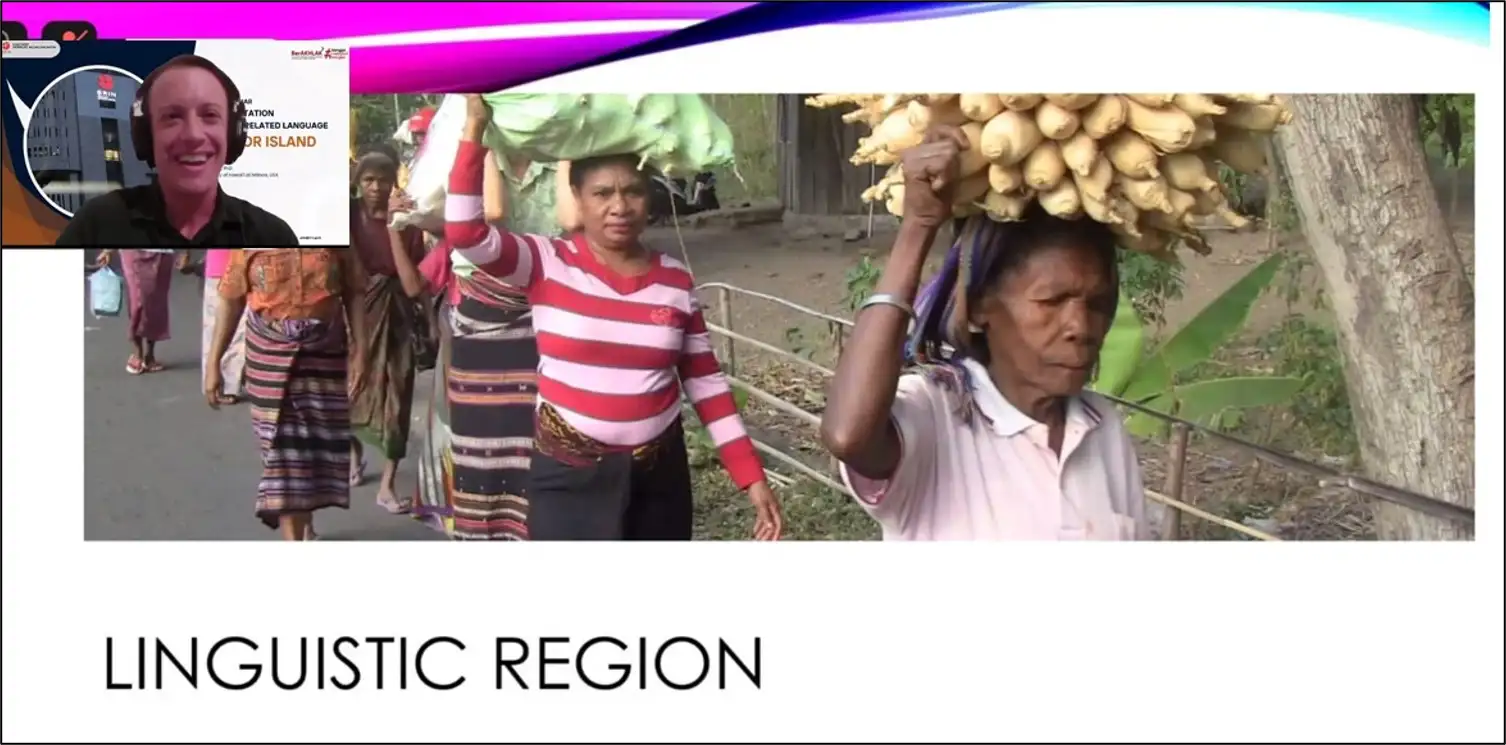
Jakarta - BRIN PR. University of Hawaii at Manoa American researcher A.L. Blake conducted research on Alor Island, East Nusa Tenggara (NTT) about plants, and their relationship with language in the form of speech practices of the Abui Tribe on the island.
According to him, the Abui Tribe is an ethnolinguistic marginalised community experiencing interrelated social, economic and environmental changes. Abui is the language of the Timor-Alor-Pantar (TAP) family. “The Abui language is threatened with extinction because the traditional ecological knowledge of the Abui community also appears to be diminishing,” explained Blake at a webinar held by BRIN's Language and Literature Preservation Research Centre (PR PBS) with the theme Documentation of Plant - Related language in Alor Island, Monday (04/11).
Blake said in his presentation that the research for his dissertation was carried out in 2016-2020 on Alor Island, NTT Indonesia, and documented it. The results of his research have been curated by corpora in endangered language archives.
“The corpora are used as data in writing the dissertation as a work of language description. This dissertation explains the basic knowledge of plants and speech practices related to the Abui community on Alor Island, Indonesia,” she explained.
Blake, as a researcher who specialises in linguistics, explains that his dissertation involves identifying, naming and classifying plants in the Abui community. Then explore, identify, and analyse plant names structurally, and semantically through coding plant names in the Abui language.
“There are times when it can be translated into Indonesian and then can be translated back into English. But there are also many that have no equivalent in Indonesian, so they cannot be translated into English,” he explained.
Blake explains that despite the important linguistic documentation of this language family, the ethnobotanical knowledge of the TAP-speaking community has been little studied.
“Moreover, the flora of Alor Island has not been thoroughly surveyed. To strengthen this research, I used a lot of videos in documenting various plants conveyed by the Abui community, as well as some supporting photos,” he explained.
The use of video as a documentation media, according to him, will be stronger if there will be further research by other researchers. Indonesia is a big nation with hundreds of regional languages.
“Quite a number of regional languages, namely tribes, are threatened with extinction. We hope this inspires other researchers to do further research, including plant researchers. The goal is that the natural wealth of a region can be preserved from extinction,” he concluded.
Meanwhile, Herry Jogaswara, Head of BRIN's Language and Literature Archaeology Research Organisation (OR Arbastra), appreciated the implementation of this webinar, which has a unique and interesting topic about plants and language.
Related to this, Herry inserted information about the programme house for research collaboration which will be carried out again in 2025.
“We offer several main themes, namely sustainable culture, archaeological big data, language and literature and archaeological basic research, as well as language and literature. We also invite researchers from within and outside the country, including universities, to jointly conduct the research collaboration,” he concluded.