News Detail
PeLUIt-40 Nuclear Reactor, Generates Electricity and Hydrogen Production
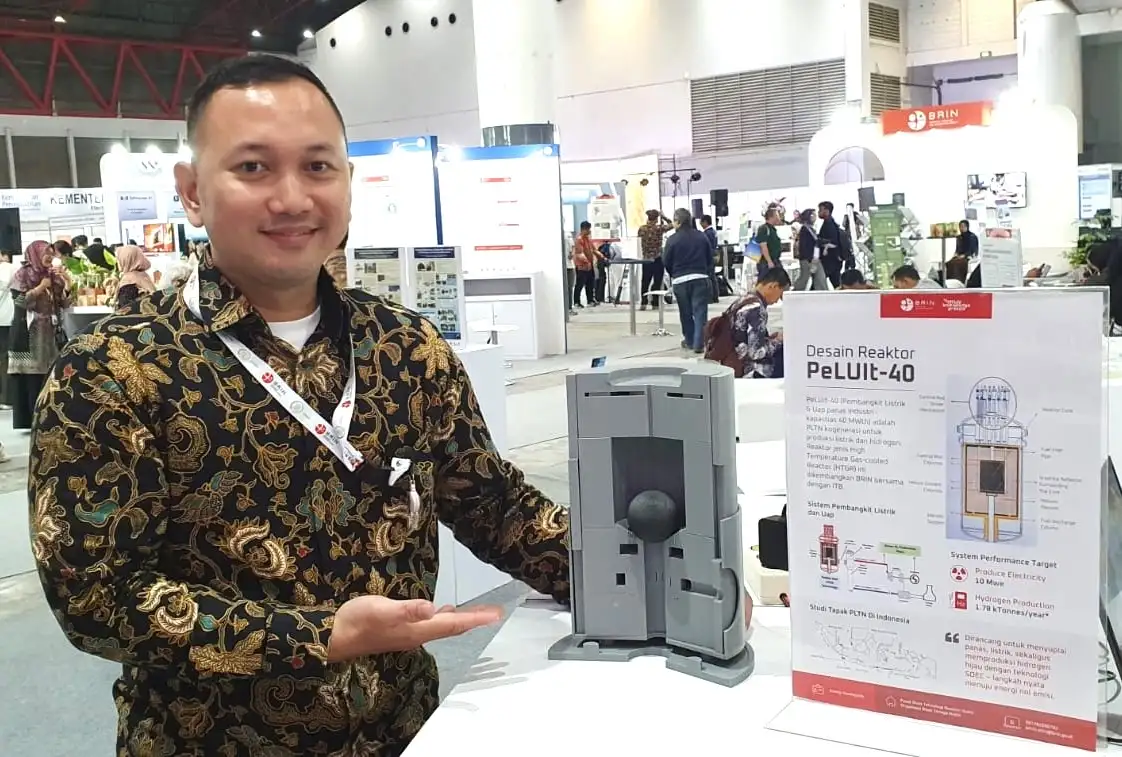
Jakarta - BRIN Public Relations. The National Research and Innovation Agency (BRIN) is developing a fourth-generation power reactor design called PeLUIt-40, which stands for Power and Steam for Industry. PeLUIt-40 has a thermal power capacity of 30 MWth to generate 10 MWe of electricity.
This reactor is designed to produce electricity while also supporting clean hydrogen production for national industrial needs.
Muhammad Subhan, a researcher at BRIN's Research Center for Nuclear Reactor Technology, explained that PeLUIt-40 is an advanced development of the Experimental Power Reactor (RDE) project from 2016–2019. “While the RDE previously had a capacity of 10 MWt, PeLUIt-40 has been upgraded to 30 MWth to be more economically viable,” said Subhan in an interview with BRIN’s Public Relations at the Indonesia Research and Innovation Expo (InaRI Expo 2025), JIEXPO, Kemayoran, Jakarta, on Tuesday (28/10).
This power increase allows the reactor not only to generate electricity but also to produce up to 1.78 kilotons of clean hydrogen per year. "The output is hot steam. From this hot steam, hydrogen can be produced using solid oxide electrolysis cell (SOEC) technology, making it truly clean energy," he explained.
PeLUIt-40 was developed based on Indonesia's experience in developing the RDE design, a small-scale reactor with high-temperature gas cooling (High Temperature Gas-cooled Reactor/HTGR). "PeLUIt-40 continues that concept with greater capacity and performance," he said.
In its development, BRIN collaborated with Bandung Institute of Technology (ITB) and Tsinghua University, China. "We learned from the Joint Laboratory with Tsinghua, which has already created the HTR-10 prototype and its commercial version, the 250 MWt HTR-PM," said Subhan.
The PeLUIt-40 design adapts fourth-generation HTGR technology, with helium coolant and triple-coated TRISO fuel spheres.
Technology and Design Stages
PeLUIt-40 uses TRISO fuel containing triple-coated uranium particles to withstand heat and radiation. "The shape is similar to a guava, with small seeds inside, but the content is uranium. The TRISO coating makes this fuel very safe," explained Subhan.
This reactor uses helium as a coolant, not water as in conventional reactors. Helium gas is circulated among the fuel to absorb heat up to 800 degrees Celsius, then directed to the steam generator system to produce high-pressure steam up to 520 degrees Celsius to drive turbines.
"With a cogeneration system, a single reactor can produce both electricity and industrial steam simultaneously, including for hydrogen production," he added.
Currently, the development of PeLUIt-40 has reached the basic design stage. The reactor design stages include conceptual design, basic design, detailed engineering design (DED), and construction. "We are now at the basic design stage. After that, we will move on to DED, where all components and specifications are calculated in detail," said Subhan.
Before construction, the design must be reviewed and approved by BAPETEN as the nuclear regulatory agency. “We are preparing the design approval documents before moving to the construction phase,” he added.
Potential Locations
PeLUIt-40 is designed to meet industrial electricity and heat needs in various regions, featuring generation 4 safety measures and low power requirements. Essentially, PeLUIt-40 can be built near industrial areas that require steam and heat supply, or directly supply hydrogen.
Currently, BRIN, together with the Ministry of Energy and Mineral Resources, is also reviewing commercial nuclear power plants for modular types (SMR) in several strategic locations. Based on BRIN’s site assessment, some potential locations include the Bangka Belitung Islands in Sumatra, Muria, West Kalimantan, and the Batam Islands.
"This field study is important to assess the geological, tectonic, and nuclear safety feasibility," said Subhan.
According to him, the government's plan to accelerate the development of a 250 MWt nuclear power plant in Sumatra and Kalimantan opens opportunities for PeLUIt-40. "This design can be modularized like a puzzle, just multiplied according to power needs. If five 30 MWt modules are installed, it would already be 150 MWt," he explained.
He added that since 2022, Pertamina has shown interest in collaborating in hydrogen production. This industry collaboration is expected to accelerate the use of nuclear energy to support national decarbonization.
Microreactors for Remote Areas
In addition to PeLUIt-40, BRIN is also developing the Micro PeLUIt, a small reactor with a capacity of 5–10 MWth that is portable. “While PeLUIt-40 is land-based, this microreactor can be transported by trailer truck or ship to remote areas,” explained Subhan.
This program supports dedieselization, which is the replacement of diesel-powered electricity plants on small islands with clean energy sources. “Subsidiaries for diesel in remote areas reach trillions of rupiah every year. If replaced with microreactors, it could be far more efficient and sustainable,” he said.
Subhan emphasized that Indonesia is quite ready for the development of nuclear power plants. Out of 19 infrastructures assessed by the International Atomic Energy Agency (IAEA), almost all are ready, including human resources, regulations, and facilities. “Now it’s just a matter of the government’s political decision and the establishment of NEPIO (Nuclear Energy Program Implementation Organization),” he explained.
He commented that Indonesia’s human resources are strong thanks to the long experience of institutions such as BRIN and BAPETEN. “We have many reactor experts and safety analysts. Even the United Arab Emirates initially lacked human resources, yet they were able to build nuclear power plants through collaboration with Korea,” he said.
According to Subhan, public perception of nuclear energy is also becoming increasingly positive. Moreover, with the growing energy demand and the policy to stop the development of coal-based power plants, “To achieve net zero emissions by 2060, we need a reliable clean energy source, and nuclear is the answer,” he stressed.
Although still in the design stage, BRIN continues to innovate. Several patents have been produced, especially for hydrogen production systems and TRISO fuel designs. "PeLUIt-40 is a tangible step for Indonesia towards its first nuclear power plant in the country. This is proof that we are capable of mastering our own power reactor technology," Subhan concluded optimistically.