News Detail
SIPSN 2024: 32% of Waste Officially Processed, the Rest Still Threatens the Environment
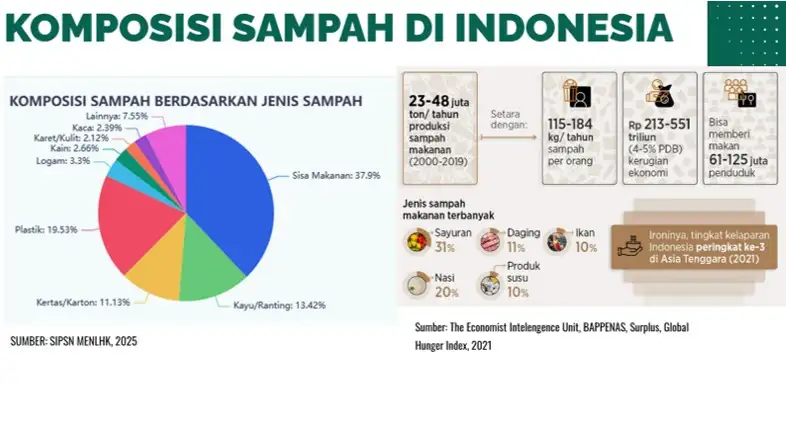
Jakarta – BRIN Public Relations. According to data from the National Waste Management Information System (SIPSN) of the Ministry of Environment and Forestry in 2024, from 342 reporting regencies/municipalities, approximately 37.3 million tons per year—or only 32%—were properly managed.
“Various studies in Indonesia show that organic waste dominates total waste generation. This means that more than half of landfill burden can actually be handled directly with the right technology,” explained Yopi, Deputy for Regional Research and Innovation (RID) BRIN, at the Dissemination of Best Practices in Organic Waste Management Based on Black Soldier Fly (BSF) within the Circular Economy System, Monday (08/12).
In reality, Yopi added, conditions on the ground show an opposite situation: more than 70 landfills (TPA) in Indonesia still use open dumping. Many small and medium regions have landfills that have already reached maximum capacity.
“Methane emissions from landfills also significantly contribute to greenhouse gases. Meanwhile, waste management burdens local budgets (APBD) and does not create added value,” he said.
For these reasons, Yopi continued, organic waste is not merely an environmental issue, but is closely tied to regional development issues, including public health and the economy.
“In this context, BSF-based waste management innovation becomes one of the most relevant options today. We see three main advantages of BSF technology: first, it can reduce landfill gas emissions by 70–90% in a short period,” he explained.
Second, BSF produces economically valuable products, such as maggot for animal feed and fertilizer. Third, it encourages community-based circular economy development by empowering local communities.
“Through the RID Deputy, BRIN consistently encourages regional governments to strengthen the development of their flagship products. Positive side effects of BSF innovations such as maggot and compost clearly strengthen agricultural, livestock, and fisheries value chains,” he said.
He emphasized that BSF-based practices should be studied and—where possible—replicated across various regions.
“We hope more regional governments adopt best practices and utilize technology to solve regional issues more efficiently, effectively, and sustainably,” he added.
Meanwhile, Aula Sakinah Muntasyarah, Widyaiswara of BPSDMD NTB Province / BSF Lombok Site Manager, explained that according to KLHK (2023), food waste accounts for 41.4% of Indonesia’s total waste. Each person contributes 115–184 kg of food waste per year.
“If utilized properly, this could meet the nutritional needs of 61–125 million Indonesians. The economic loss reaches Rp 213–551 trillion per year. Food waste contributes 7.29% of annual GHG emissions. Indonesia is the largest food waste producer in ASEAN, generating 14.73 million tons per year,” said Aula.
Nationally, she noted, 60–70% of waste in Indonesia is transported to landfills, while the rest is burned, illegally dumped, or buried. The TPA Leuwigajah (West Java) disaster pushed many cities to improve waste management systems and adopt the 3R (Reduce, Reuse, Recycle) approach.
“There are 59,000 temporary waste collection points (TPS) across Indonesia. Waste management is carried out by municipal/regional governments and significantly supported by the informal sector,” Aula explained.
The effectiveness of BSF in processing waste is high: about 50% of Indonesia’s waste is organic, and 40% of it is food waste, meaning BSF can significantly reduce landfill loads. BSF larvae can process up to 56% of organic waste, and BSF Lombok has recorded a 50% conversion rate.
“Organic waste processing is fast—approximately 17 days. The cost of establishing and operating BSF facilities is relatively low. The process generates several reusable products that support food security, such as fresh larvae and organic fertilizer (frass),” she noted.
Aula added that two waste categories can be processed: urban waste (municipal organic waste, restaurant food waste, market waste) and agro-industrial waste (food processing residues, used grains, slaughterhouse waste).
“BSF supports food security because its products can be used as livestock feed and organic fertilizer. The establishment of BSF facilities should be integrated with agricultural planning,” she said.
BSF also supports biodiversity protection and ecosystem conservation. Its larvae are a high-protein feed source (45–60%) at an affordable price.
“From five years of operating BSF Lombok, if replication is attempted, the managing community group must be established alongside facility construction. BSF development must go hand-in-hand with capacity building for community waste managers,” she emphasized.
Engaging local leaders is essential, she added, and sustainability depends on factors such as waste assessment, supportive regulations, market availability, and infrastructure. “Integrity and multi-stakeholder collaboration are crucial, and continuous monitoring and evaluation are required,” she concluded. (ns)