News Detail
Home to Millions of Specimens, the Bogor Zoological Museum Preserves Southeast Asia’s Largest Faunal Collection
Jakarta – BRIN Public Relations. The National Research and Innovation Agency (BRIN) continues to strengthen the role of the Bogor Zoological Museum (Museum Zoologi Bogor/MZB) as a key reference center for scientific animal (faunal) collections. Established in 1894, the museum currently manages millions of animal specimens and is recognized as one of the largest zoological museums in Southeast Asia, ranking among the top ten worldwide in terms of the richness and completeness of its scientific animal collections.
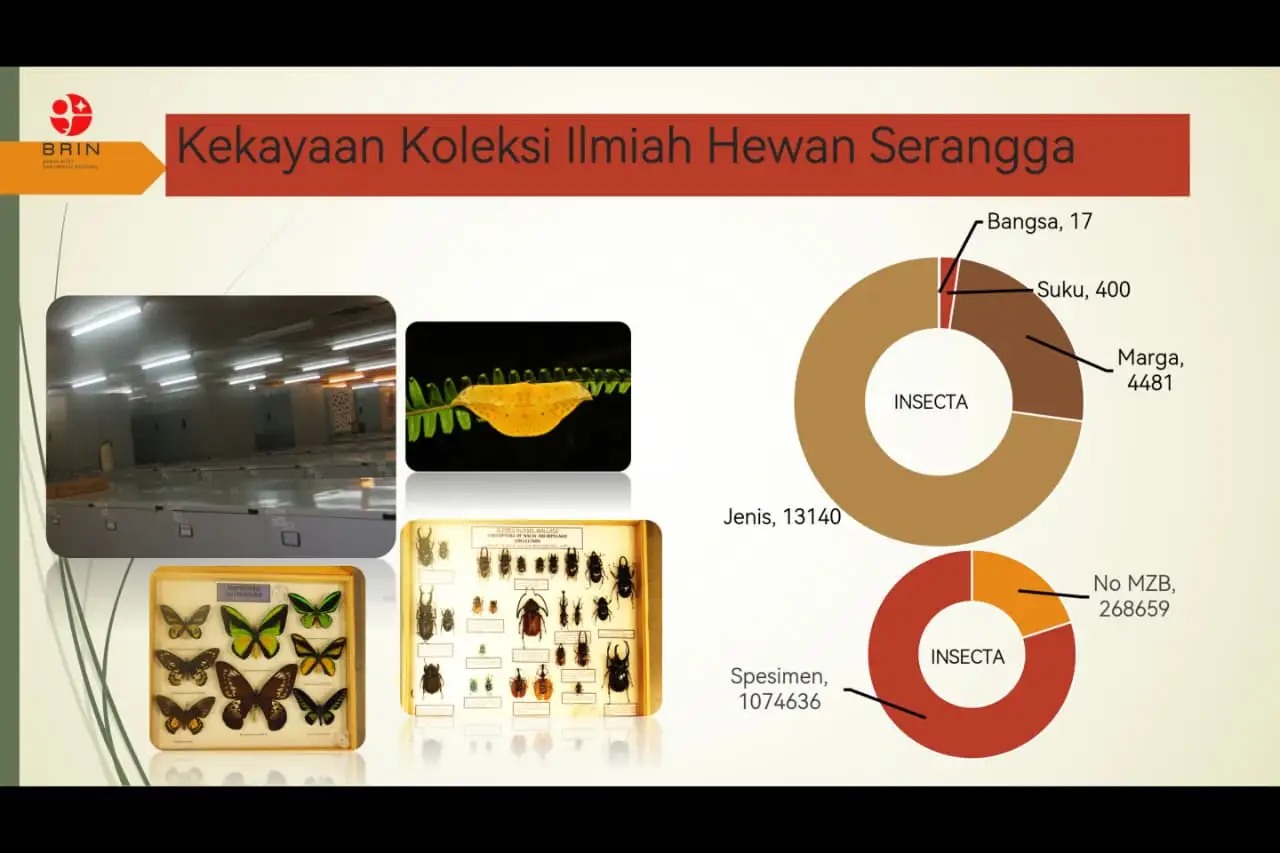
“Currently, the Bogor Zoological Museum manages an exceptionally large and diverse scientific animal collection. The collection is dominated by insects, with more than 1.07 million specimens,” said Darmawan, a member of the Animal Scientific Collection Processing Team, during the TakSon “Talk about Scientific Collection” Series #5, organized by the Directorate of Scientific Collection Management, BRIN, on Tuesday (8/12).
In addition, Darmawan explained that the museum houses approximately 143,000 mollusk and fish specimens, more than 101,000 amphibian specimens, around 91,000 reptile specimens, over 85,000 mammal specimens, approximately 78,000 specimens of other arthropods, as well as tens of thousands of bird and crustacean specimens. Other groups, such as echinoderms, nematodes, and platyhelminths, are represented in smaller numbers but remain highly valuable as scientific references.
Darmawan added that all collections undergo standardized processing stages, including exploration, preparation of dry and wet specimens, labeling, identification, documentation, digitalization, and sterilization at temperatures reaching minus 20 degrees Celsius. “These processes are carried out to ensure that the quality of the collections is maintained and that they can be utilized over the long term,” he said.
Furthermore, Darmawan emphasized that the scientific animal collections of the Bogor Zoological Museum serve not only as archives of biodiversity, but are also widely utilized for taxonomic and systematic research, conservation status assessments, biodiversity monitoring, biotechnology and health development, as well as educational media and public awareness enhancement.
The museum also provides animal identification services for students, researchers, and government as well as private institutions. These services are considered crucial in supporting research activities, education, and evidence-based policymaking.
Through integrated management, supported by qualified human resources and internationally standardized infrastructure, BRIN is committed to positioning the Bogor Zoological Museum as a national scientific collection center with global competitiveness. “We hope that the richness of the scientific animal collections can continue to be optimally utilized to support the advancement of science and sustainable development in Indonesia,” he concluded.
As is well known, the Bogor Zoological Museum originated from the Landbouw Zoologisch Laboratorium, established on 23 August 1894 on the initiative of Dutch botanist J.C. Koningsberger. Over time, the institution underwent several name changes before becoming known as the Bogor Zoological Museum. In 1997, all collections were relocated from Bogor to Cibinong, supported by internationally standardized facilities built through grants from the World Bank and Japan. (ea/ed: jml)