News Detail
BRIN and Russia Strengthen Collaboration to Accelerate the Biak Spaceport
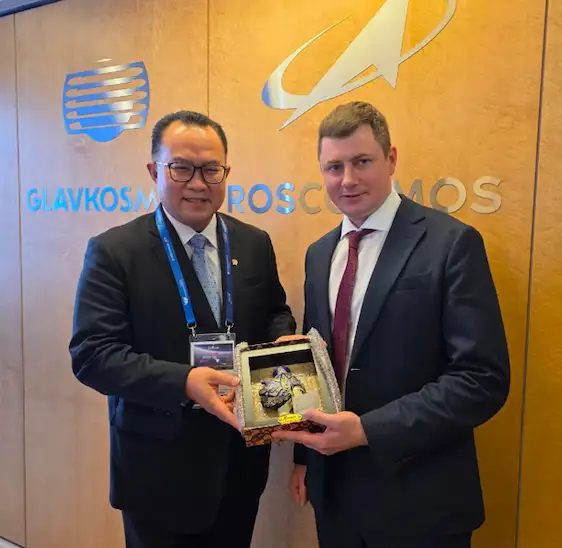
Jakarta—BRIN Public Relations. The National Research and Innovation Agency (BRIN) is committed to accelerating the construction of the national spaceport on Biak Island, Papua. This commitment is demonstrated through strengthened cooperation with the Russian space agency, Roscosmos.
This strengthened cooperation took place during a visit by Chairman of BRIN Arif Satria to Roscosmos headquarters in Russia on Wednesday (April 8, 2026). The collaboration with Roscosmos is a strategic step in supporting Indonesia’s ambition to build the first spaceport in Southeast Asia.
While touring Glavkosmos, Chairman of BRIN also explored opportunities for further cooperation, particularly regarding the commercialization of space services. According to Arif Satria, the construction of the spaceport in Biak requires global collaboration, especially with countries possessing advanced experience and technology in the space sector.
“Since we are now planning to build a spaceport on Biak Island, Papua, and of course one of the best in space technology is Russia. Russia is one of our partners in developing our space ecosystem,” he said on Tuesday (April 14).
Biak was chosen because of its proximity to the equator. This provides technical advantages and energy efficiency for launching rockets into various types of satellite orbits. Biak also has an open view of the Pacific Ocean, allowing first-stage rockets to fall into the open sea.
Additionally, the availability of basic infrastructure such as ports and airports in Biak is a distinct advantage, as it facilitates the distribution and transportation of rocket components manufactured at other locations.
Arif Satria is optimistic that the partnership with Roscosmos can accelerate the realization of Indonesia’s vision: to become the first country in Southeast Asia to have a spaceport.
“We believe that Russia, with its experience and new advanced technology, can help Indonesia achieve our dream of becoming the first country in Southeast Asia to have a spaceport,” he said.
Furthermore, Arif emphasized that the construction of the spaceport is not merely an infrastructure project, but part of a broader strategy to build a national space ecosystem that will have an economic impact.
“Because the space ecosystem is so important, when we talk about the space ecosystem, we’re not just talking about rockets. The ecosystem boosts the economy, so it’s not just about public facilities, but also about economic activities,” said Arif.
Through this strengthened cooperation, Arif hopes that the construction of the spaceport in Biak can serve as a catalyst for the growth of high-tech industries while simultaneously reinforcing Indonesia’s sovereignty in the space sector.
“We hope our capabilities will grow stronger, enhancing our ability to create a space ecosystem,” he said. (SBN)