News Detail
BRIN and The University of Osaka Strengthen Ultrafast Laser Research, Driving Future Materials and Telecommunications Innovation
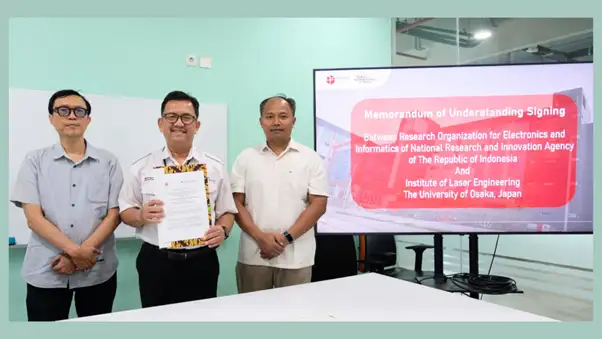
Bandung – National Research and Innovation Agency Public Relations. The National Research and Innovation Agency (BRIN) continues to expand its global research network through strategic collaborations in advanced technologies. This time, BRIN, through the Research Organization for Electronics and Informatics (OREI), has established cooperation with the Institute of Laser Engineering (ILE), The University of Osaka, in the development of laser- and photonics-based research.
The collaboration was marked by the signing of a Memorandum of Understanding (MoU) by the Head of OREI BRIN, Budi Prawara, through a desk-to-desk signing process at the Samaun Samadikun Science and Technology Area in Bandung on Monday (20/4).
This partnership opens significant opportunities for BRIN researchers to access advanced laser technologies owned by ILE, including ultrafast optical pulse technology at picosecond to femtosecond scales. The technology enables highly precise observation and control of material phenomena, even within terahertz and exahertz frequency ranges — an achievement positioned at the forefront of modern science.
Researcher at the Research Center for Electronics BRIN, Rike Yudianti, explained that the collaboration will strengthen synergies between fundamental and applied research. BRIN contributes through its human resource expertise in telecommunications, optics, photonics, and advanced materials, which form the foundation for the development of future electronic devices.
“Through this collaboration, BRIN researchers can conduct advanced material characterization using techniques such as terahertz spectroscopy, ultrafast quantum state control, and electromagnetic material engineering based on metamaterials,” she stated.
In addition, according to Rike, the collaboration also emphasizes human resource capacity development through researcher and student exchange programs, joint supervision, as well as training and competency enhancement initiatives. The program serves as a gateway for young Indonesian researchers to directly engage with advanced laser technologies and global scientific networks.
The research to be developed covers various strategic fields, including laser-material interactions, nonlinear optics, high-precision optical diagnostic techniques, and the development of next-generation telecommunications technologies beyond 5G and 6G. Furthermore, the application of laser-based spectroscopy techniques such as THz and Raman spectroscopy will deepen understanding of material structures and dynamics.
“Through this MoU, we hope to strengthen joint research outputs, accelerate innovation in optics and advanced materials, and enhance the competitiveness and scientific impact of both institutions at the global level,” said Rike.
Head of the Research Center for Electronics BRIN, Yusuf Nur Wijayanto, assessed that the collaboration holds significant potential in utilizing shared research infrastructure, knowledge exchange, and strengthening international scientific publications.
“This collaboration is expected to accelerate innovation in optics and advanced materials, while also enhancing the global competitiveness of Indonesian research,” he concluded.
By integrating laser-based research infrastructure capabilities with multidisciplinary expertise, the collaboration between BRIN and Institute of Laser Engineering Osaka represents a strategic step toward developing future technologies with broad impacts, ranging from advanced electronic devices to next-generation telecommunications systems. (cw/ed:kg, ugi).