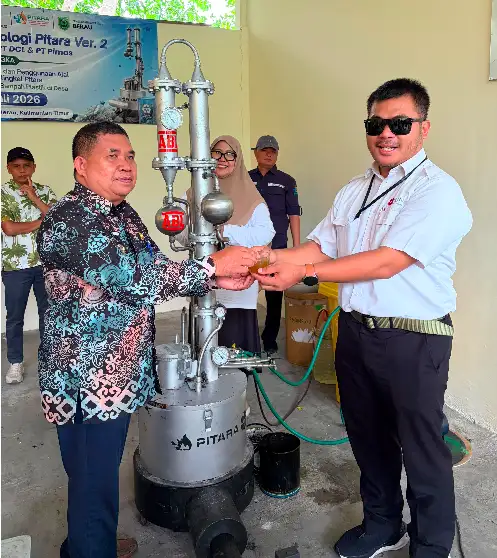
Berau – BRIN Public Relations. The National Research and Innovation Agency (BRIN) is accelerating the downstream utilization of research results through the implementation of PITARA Pyrolysis Technology (Tiered Tube Pyrolysis) Version 2 at the Reduce, Reuse, Recycle Waste Processing Site (TPS3R) on Derawan Island, Berau Regency, East Kalimantan. This technology, which is capable of converting low-value plastic waste into fuel oil, serves as one of the research-based solutions to support sustainable waste management while simultaneously strengthening the circular economy in the island region.
The implementation of the technology, which took place from July 20–24, 2026, was the result of a collaboration between BRIN, PT Asian Bulk Logistics (ABL) Group, the Berau Regency Government, and the management of the TPS3R on Derawan Island. This collaboration serves as an example of how national research outcomes are applied in practice to address environmental issues faced by the community.
Chairman of Research Organization for Energy and Manufacture, Cuk Supriyadi Ali Nandar, stated that the implementation of PITARA Ver. 2 is part of BRIN's strategy to accelerate the commercialization of innovations so that research outcomes do not remain only as scientific publications or laboratory prototypes.
"BRIN is committed to promoting research outcomes so that they do not stop at the laboratory scale, but can be applied to meet the needs of society. The implementation of PITARA Ver. 2 technology at the TPS3R Pulau Derawan is a concrete example of how plastic waste processing innovations can support a circular economy, generate alternative energy, and strengthen regional capacity in realizing sustainable waste management," said Cuk.
PITARA technology is a pyrolysis innovation developed by a team of BRIN researchers in collaboration with BRIDA Central Java Province to process hard-to-recycle plastic waste into fuel oil through a heating process without oxygen. This technology is designed to be applicable at the community scale with relatively efficient operational costs.
In addition to generating alternative energy, the implementation of PITARA is also expected to reduce the volume of plastic waste, which has long been a major issue in island tourist areas such as Derawan Island. Through this approach, waste that previously had no economic value can be transformed into an energy source beneficial to the community.
Head of Research Center for Sustainable Industrial and Manufacturing Systems, Nugroho Adi Sasongko explained that the success of innovation downstreaming heavily depends on the collaboration between research institutions, local governments, the business sector, and the community.
According to him, the implementation of PITARA in Derawan Island is positioned as a national pilot project that will serve as a reference for the application of plastic waste processing technology in the Indonesian archipelago.
"The implementation of the PITARA Ver. 2 Pyrolysis technology in the Derawan Islands can convert low-value plastic waste into BBMT equivalent to kerosene. The price of kerosene here reaches around Rp20,000 per liter, so it is hoped that this machine can help provide the much-needed energy for communities in archipelagic areas such as Derawan," explained Nugroho.
Not only introducing technology, BRIN also develops the Living Laboratory (Living Lab) model so that the community becomes part of the innovation process. Residents are involved from raw material collection, installation operation, to the utilization of production results, enabling the technology to be operated independently and sustainably.
As part of this implementation, BRIN organizes Training of Trainers (ToT) and technical assistance for the managers of the Pulau Derawan TPS3R. A total of 10 operators received training to ensure the technology can be operated optimally while also enhancing the capacity of local human resources
This program is also aimed at building a circular economy ecosystem that aligns with the characteristics of Derawan Island as a marine tourism area. Waste management, alternative energy production, and the utilization of the resulting outputs are developed based on local resource potential, thereby creating new business opportunities while reducing environmental pollution.
This collaboration also receives support from PT Asian Bulk Logistics (ABL) Group through its corporate social responsibility (CSR) program, which focuses on environmental conservation and community empowerment. The synergy between the business sector, local government, and BRIN is expected to serve as a model for accelerating the utilization of national research results.
The collaboration also received support from PT Asian Bulk Logistics (ABL) Group through its corporate social responsibility (CSR) program, which focuses on environmental conservation and community empowerment. The synergy between the business sector, local government, and BRIN is expected to serve as a model for accelerating the utilization of national research results for sustainable development.
"We believe that sustainability can only be achieved through collaboration. For ABL Group, this collaboration is part of the company's journey in supporting sustainable development targets, particularly in the areas of environmental management, waste reduction, and community empowerment in the company's operational regions. Supporting the implementation of pyrolysis-based technology is part of our commitment to providing tangible solutions to environmental challenges, while also encouraging the creation of added value for the community through practical innovations. This is part of the Environmental Preservation CSR Pillar at ABL Group," said Hermawan.
Hermawan hopes that through the implementation of PITARA Ver. 2 on Derawan Island, the presence of research within the community can provide direct benefits, and in the future, this technology downstreaming model can be replicated in various other regions in Indonesia as a solution for plastic waste management based on innovation while simultaneously strengthening national energy resilience and the circular economy. (pur)