News Detail
ANSTO Visits BRIN Facilities to Explore Nuclear Technology Collaboration
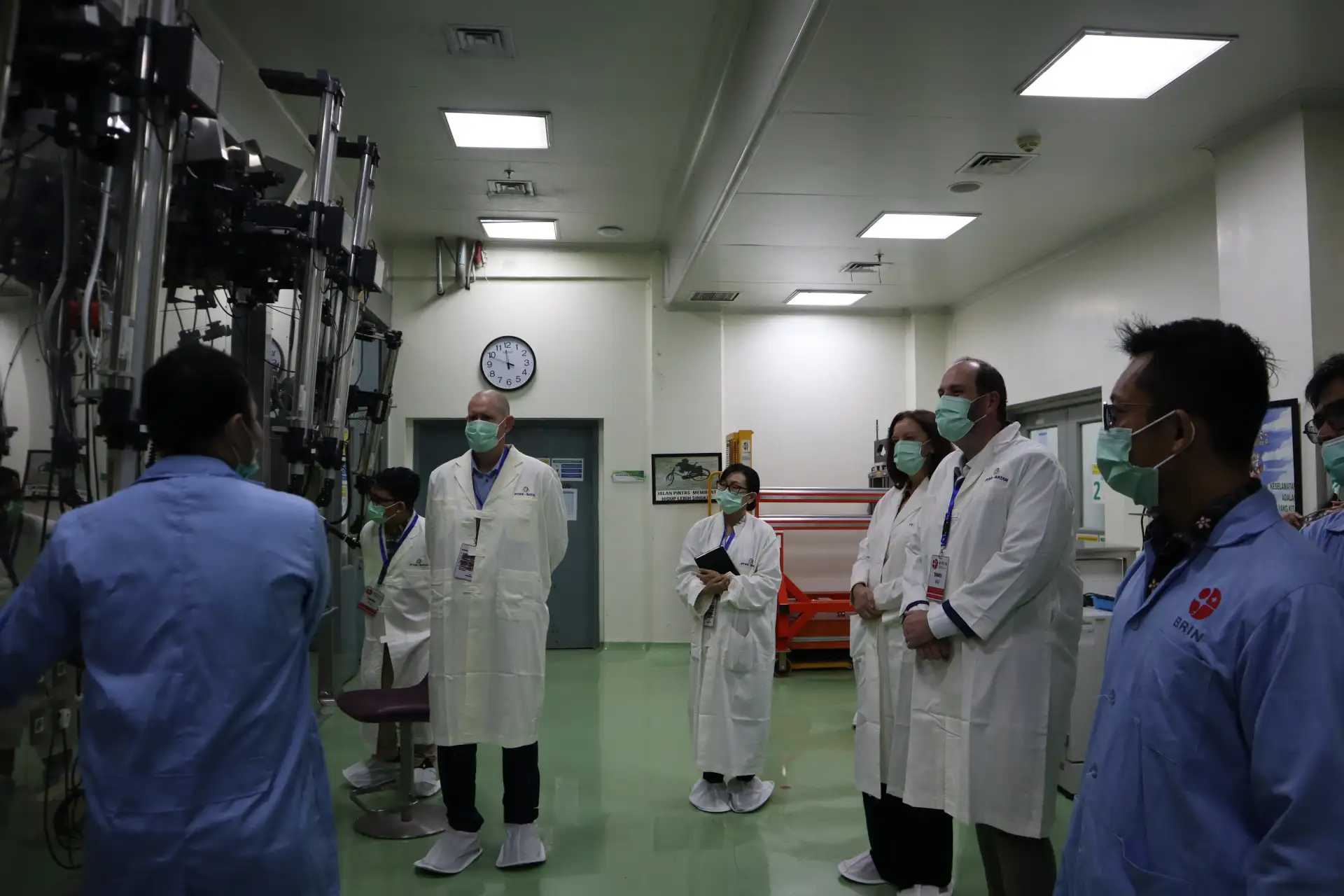
South Tangerang – BRIN Public Relations. The National Research and Innovation Agency (BRIN) and the Australian Nuclear Science and Technology Organisation (ANSTO) are exploring cooperation in a number of fields, including radiation technology, radioisotope and radiopharmaceutical production, as well as nuclear safety and security. These exploratory discussions continued with a visit by an ANSTO delegation, accompanied by the Australian Embassy in Indonesia, to BRIN’s Radioisotope and Radiopharmaceutical Technology Facility at the B.J. Habibie Science and Technology Park in Serpong on Tuesday (August 11).
During the visit, the ANSTO delegation observed firsthand BRIN’s research capabilities and facilities, which have the potential to support cooperation between the two institutions. This activity is a follow-up to previous discussions held at the B.J. Habibie Building in Jakarta.
Dimas Irawan, Team Leader at BRIN’s Directorate for Environment, Maritime, Natural Resources, and Nuclear Policy, stated that there are 10 areas of mutual interest between BRIN and ANSTO. Some of these include radiation processes and the use of technology for radioisotope and radiopharmaceutical production.
“In addition to nuclear radiation technology, ANSTO is also interested in collaborating in the field of nuclear safety and security,” said Dimas.
Strengthening nuclear safety and security capacity was one of ANSTO’s proposals during the cooperation discussions. Both institutions also recognized the importance of stakeholder engagement, particularly to align research outcomes with the needs of prospective users and the public.
“One very important aspect is how we can commercialize the technologies developed by BRIN and ANSTO for potential users and the public,” he said.
In line with these exploratory discussions, a number of initial activities have been planned, even though the process of drafting and signing a Memorandum of Understanding (MoU) is still ongoing. One such activity involves a visit by BRIN researchers to ANSTO’s cyclotron and radiopharmaceutical production facilities within the next semester.
In addition to the facility visits, ANSTO has offered to hold joint workshops for researchers from both institutions as a means of knowledge exchange, particularly regarding the themes that will be the focus of the collaboration.
Executive Group, Nuclear Science and Technology at ANSTO, Andrew Gareth Peele, said that cooperation with BRIN also has the potential to be expanded into the environmental and health sectors, as well as the utilization of large-scale research infrastructure.
“We are exploring several areas such as environmental research, health research, and the use of large-scale research infrastructure, and several initial projects will receive funding support from the Australian government,” said Peele.
He hopes that the collaboration between the two institutions will yield solutions to the challenges faced by both countries, benefit the public, and support downstream development in the environmental, health, and economic sectors. (msb, mpd/ed. jnn)