News Detail
Beware of Super El Niño 2026–2027, BRIN Strengthens Cross-Border Mitigation
Jakarta - BRIN Public Relations. The 2026–2027 Super El Niño phenomenon has the potential to trigger prolonged dry seasons and extreme heat stress across several regions of Indonesia. This condition necessitates enhanced preparedness and international research collaboration to mitigate its impacts.
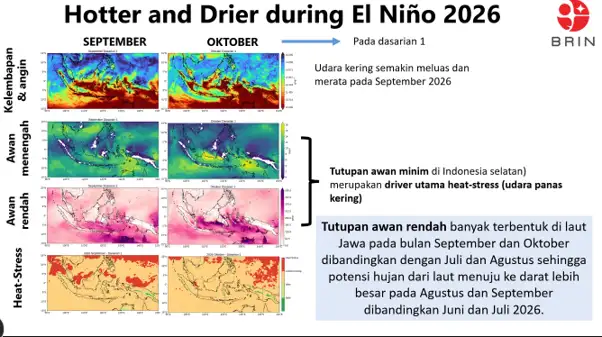
Senior Researcher at Research Center for Climate and Atmosphere (PRIMA) BRIN, Erma Yulihastin, stated that the impacts of the 2026–2027 El Niño across the Indonesian Maritime Continent exhibit increasingly complex spatial patterns that can no longer be simplified based on the equator.
“The propagation of El Niño waves triggers shifts toward extended dry seasons and elevates the threat of extreme heat stress, measured by the Wet Bulb Global Temperature (WBGT) index,” Erma explained during an international webinar titled “El-Nino 2026-2027: From Global Climate Signal to Local Action: Preparing Indonesia and the United States for an Unprecedented Climate Challenge” on Tuesday (29/9) in Jakarta.
According to Erma, local variations were evident in 2026. The Bogor region continued to experience frequent rainfall due to local conditions and mountainous topography, whereas Lamongan, East Java, endured a significantly longer dry period.
Her team's research also highlighted risks to rice production and environmental heat stress. Measurements using the WBGT index indicate that Kalimantan and Papua possess high vulnerability to thermal stress alongside an increased risk of forest fires.
Based on simulations and analysis from 14 NASA NEX-GDDP climate models, Erma noted that drought threats driven by El Niño are projected to persist into the 2027–2028 period. These findings underscore the need for long-term vigilance among various stakeholders.
Meanwhile, Mark Merrifield from the Scripps Institution of Oceanography reported that sea surface temperature anomalies in the Equatorial Pacific have displayed strong signals pointing toward a Super El Niño phase, expected to last into early 2027.
"For the October to December 2026 season, there is a 75% probability that this event will become a historic milestone, surpassing the intensity of previous El Niño records since the 1950s," Mark stated during the online webinar conducted via Zoom.
Mark also detailed localized impacts in coastal areas, such as along the California coast, which faces heightened surf, elevated sea levels, extreme high tides, and heavy rainfall triggering coastal flooding risks. Cross-regional research experiences like these demonstrate the importance of implementing adaptive observation systems, including for Indonesia.
Strengthening cross-border collaboration is a vital step toward anticipating extreme El Niño impacts. The Embassy of the Republic of Indonesia in Washington, D.C., Dwisuryo Indroyono Soesilo, emphasized the critical importance of international synergy in facing extreme climate threats.
"Understanding El Niño is only valuable if that understanding translates into improved preparedness for governments, communities, and individuals. This must be backed by a shared commitment, including operational readiness of BRIN's research vessel Baruna Jaya to collaborate in analyzing climate dynamics to protect our people," Dwisuryo stated.
Dwisuryo added that the collaboration between BRIN and the Scripps Institution of Oceanography marks the beginning of a series of long-term partnerships. Both nations will follow up through detailed discussions on research proposals and joint resource mobilization to comprehensively analyze the history and dynamics of El Niño. (ais, rps/ed. mfs/translator:irf)